


A lean supply chain is a supply network designed to deliver exactly what customers need when they need it, with the least possible waste of inventory, time and effort across every tier, from planning to distribution. Lean supply chain takes the principles that made lean manufacturing successful inside manufacturing plants and applies them to the flow of materials and information between companies.
As LaSalle Group COO Mayra Marquez describes it, “Lean supply chain goes beyond removing waste and reducing costs. Lean Supply Chain is a business competitive advantage about having a reliable supply operation that is faster, better, and cost-effective than the rest of the same business competitors.”
Lean rarely fails because of the method. In our experience at LaSalle Group, it fails when planning does not keep up with operational and regulatory goals and requirements.
When the plan, the materials and production are not integrated, Just-in-Time, a foundational pillar of lean manufacturing, starts yielding shortages and constant changeovers.
This article explains what a lean supply chain is, the principles behind it, the most common pitfalls of lean in regulated manufacturing, and what we learned implementing it at a manufacturing site for a top 10 global medical device company, where the production capacity we unlocked supported more than $50 million in additional revenue capacity.
What Is a Lean Supply Chain?
What value do companies gain from a lean supply chain?
A lean supply chain:
- Shortens lead times.
- Minimizes the amount of inventory the company must finance.
- Makes problems visible sooner.
As a result, companies gain a supply chain that responds to real demand instead of building inventory against uncertain forecasts and occupying more warehouse space than necessary.
The cost of inefficient supply chains is high. The McKinsey Global Institute estimated in 2020 that companies can expect supply chain disruptions lasting a month or longer every 3.7 years on average, and that over a decade those disruptions cost them around 45 percent of one year's earnings. A supply chain that sees problems early and reacts fast protects its organization’s profitability.
At LaSalle, profit is just one factor to consider. Many of LaSalle Group’s clients are life sciences companies including medtech, pharma, biotech, and cell and gene therapy manufacturers. Within the life sciences industry there is a greater risk to consider: supply chain disruptions create variability and the risk of not being able to deliver the lifesaving and life-enhancing drugs and therapies that patients all over the world need.
Lean manufacturing vs. lean supply chain
Lean manufacturing focuses on the flow inside the four walls of the plant.
In contrast, a lean supply chain extends that flow beyond those four walls to include demand forecast management, sales and operating plans, Tier 2 and Tier 3 suppliers, inventory policies, and replenishment signals between companies.
Practices such as vendor-managed inventory (VMI), where the supplier manages stock levels at the customer site, and synchronized replenishment, where suppliers deliver in step with actual consumption, are what turn lean manufacturing into a lean supply chain from an inventory management perspective.
The cost of not running a lean supply chain
For finance leaders, lean's strongest argument is not only resilience. It is cash. Every unit of excess inventory carries a cost: capital tied up, storage, handling, obsolescence and write-offs.
Reducing that inventory shortens the cash conversion cycle and frees working capital that can be used or invested elsewhere in the business. The scale is significant: inventory carrying costs made up 28.4 percent of the $2.58 trillion US businesses spent on logistics in 2024. That adds up to about $730 billion, according to the CSCMP State of Logistics Report prepared by Kearney (2025).
What a lean supply chain is not
Lean supply chain does not mean “zero inventory everywhere.” Toyota, the company that created the Toyota Production System, and a global benchmark for lean, is the clearest example.
After the 2011 earthquake in Japan, Toyota asked its suppliers to hold between two and six months of semiconductor inventory, according to Reuters (2021). That decision was one of the reasons it was able to keep production running through the early months of the 2021 chip shortage.
That buffer may sound like the opposite of lean, but it is consistent with it. The Toyota Production System itself uses “supermarkets,” defined as controlled stores of inventory placed between processes where continuous flow is not possible. Lean eliminates waste; it does not eliminate protection. The goal is to deliberately place inventory at the highest risk points, and nowhere else.
The 5 Lean Principles Applied to the Supply Chain
James Womack and Daniel Jones codified lean thinking in five principles in their book Lean Thinking (1996). These five principles are value, value stream, flow, pull and perfection. This is how each one translates to a supply chain:
- Value. In a supply chain: define what the customer is willing to pay for. Example in a manufacturing site: on-time, in-full delivery of a released product.
- Value stream. In a supply chain: map every step from planning demand to customer. Example in a manufacturing site: a value stream map from demand planning to product distribution that shows value versus not value-added process times.
- Flow. In a supply chain: make materials and products move without stops or queues. Example in a manufacturing site: reducing waiting time between planning, production, quality testing and release.
- Pull. In a supply chain: produce and replenish based on real consumption. Example in a manufacturing site: replenishing components and finished products as they are consumed, in agreement with qualified suppliers and customer requirements.
- Perfection. In a supply chain: improve continuously. Example in a manufacturing site: Lean Six Sigma projects that reduce waste and process variations.
For a deeper introduction to the Lean methodology, see What Is Lean Six Sigma and Why Does It Matter?
Common Supply Chain Pitfalls in Manufacturing Operations
Most lean supply chain efforts that fail do not fail on the shop floor. They fail because of strategic gaps in forecasts, planning, deployment and sustainment.
These are the most common pitfalls we see in regulated manufacturing sites:
- Planning outside the ERP. Materials requirements calculated in spreadsheets outside the ERP. ERPs are then limited to placing purchase orders. The plan depends on a few people, and nobody sees the full picture.
- Materials planning that starts too late. When material requirements are calculated after production orders are committed, shortages are discovered too late and can result in halted operations.
- Small production orders and frequent changeovers. Order sizes driven by habit or old constraints instead of real capacity, which multiplies setups and machine downtime.
- No segmentation. Treating every product and material the same, instead of planning high-volume items differently from low-volume ones.
- Weak master data. Lead times, safety stocks, and batch sizes defined by experience rather than data and never reviewed.
In regulated manufacturing plants, Just-in-Time is most exposed where the rules leave little room to react. For example, a material that comes from a single qualified supplier cannot be replaced overnight because qualifying a new supplier takes time. Quality control testing and batch release add days that a pull signal does not see. And when demand rises faster than validated capacity, there is no quick way to add a line or change a process without a change control. In each case, removing the buffer removes the protection the manufacturing plant has.
What needs to happen before you move to a lean supply chain?
Before pulling inventory out of the system, manufacturing plants need a strong foundation: a reliable plan inside the ERP, clean master data, visibility of inventory and work in progress, and suppliers that can deliver to a pull signal.
Removing buffers before that foundation exists is the fastest way to turn lean into shortages. The readiness questions at the end of this article provide a quick way to start analyzing your readiness to transition to a lean supply chain.
Lean supply chain at a high SKU count
Even with that foundation in place, the SKU growth in the case study below points to a known limit of pure pull systems. When the number of SKUs rises and demand becomes more variable, it becomes harder to restock every item only as it is consumed, because each SKU needs its own pull signal, buffer size and regular review.
That challenge is one of the reasons the field developed complements such as Demand Driven MRP (DDMRP), which, as the Demand Driven Institute describes it, places strategic “decoupling point” buffers and combines elements of MRP, lean and the theory of constraints. Lean is not an unopposed doctrine; it works best when it is combined with planning that fits the complexity of the operation.
The bullwhip effect in multi-tier networks
Complexity does not stop at the plant’s walls. Small changes in customer demand tend to grow into large swings in orders as they move upstream through distributors, manufacturers, and suppliers. This behavior is called the bullwhip effect as popularized by Lee, Padmanabhan and Whang in a 1997 MIT Sloan Management Review article.
One of their examples was Procter & Gamble: consumers used diapers at a steady rate, yet the orders P&G placed with its own suppliers swung far more than retail sales. The authors traced the effect to forecast updating, order batching, price fluctuations and shortage gaming. A lean operation inside one plant cannot fix it on its own: it requires sharing real demand information across the chain, and the swings it creates are hardest to absorb when supplier lead times are long.
High demand variability and long supplier lead times
Pull systems work best when demand is stable and suppliers can respond quickly. When demand swings or supplier lead times are long, pure pull runs out of time to react. Christopher and Towill (2001) argued that these conditions call for combining lean with agile approaches: lean where demand is predictable, buffers and flexibility where it is not. The case below is an example: a demand increase of up to 35 percent could not be absorbed by a planning process that only saw one week ahead.
Case Study: From Reactive Planning to Lean Flow
At LaSalle Group, we worked with a manufacturing site for a top 10 global medical device organization that was facing issues with their supply chain. We were asked to assess supply chain operations at one of the organization’s sites in the Americas.
The symptoms were ones most regulated plants recognize.
- Lines stopped waiting on material.
- Format changes consumed shifts that had been planned for production.
- Planners spent their days resequencing rather than planning.
- Operational efficiency ran below 70 percent.
- Furthermore, one order in four left the site late or incomplete, against a 97.5 percent OTIF target.
The site read this as an execution problem, and most of the proposed remedies pointed at the shop floor. The diagnosis was wrong in an instructive way. After our initial assessment, our data pointed at the planning process.
Demand had risen by as much as 35 percent. The catalog portfolio went from 4,900 SKUs to roughly 12,000 SKUs in a three-year timeframe. Inbound supply was an issue with supplier delivery performance at 81 percent against a 98 percent target. In addition, pandemic-led absenteeism thinned the crews running the shopfloor creating an increasingly fragmented schedule. Last but not least, planning, materials and production scheduling teams each worked from their own version of the truth and reconciled them after the fact, on a horizon of about one week.
This is the type of scenario under which Just-in-Time stops being a discipline and becomes an exposure.
Pull signals are only as good as the demand picture behind them. When the plan, the materials and the schedule are not integrated, every normal fluctuation in supply or absenteeism converts directly into a shortage, and every shortage is absorbed by resequencing, which means another changeover.
The plant was not failing to execute lean. It was executing without the planning layer that makes pull viable.
Our team of experts identified this as the most critical point and therefore the starting focus of our engagement. Planning, materials and production scheduling were brought onto a common cadence and a shared demand signal. We built a planning horizon long enough to level the schedule rather than react to it. Only once the plan was stable did lot sizing become a lever worth pulling.
Our efforts then turned to lot sizing. Lot sizes were improved and a segmentation strategy was implemented. This change simultaneously improved changeover and production execution and resulted in an increase of 35% additional units of capacity in just 8 months. Moreover, we increased capacity without new equipment investments nor capital projects.
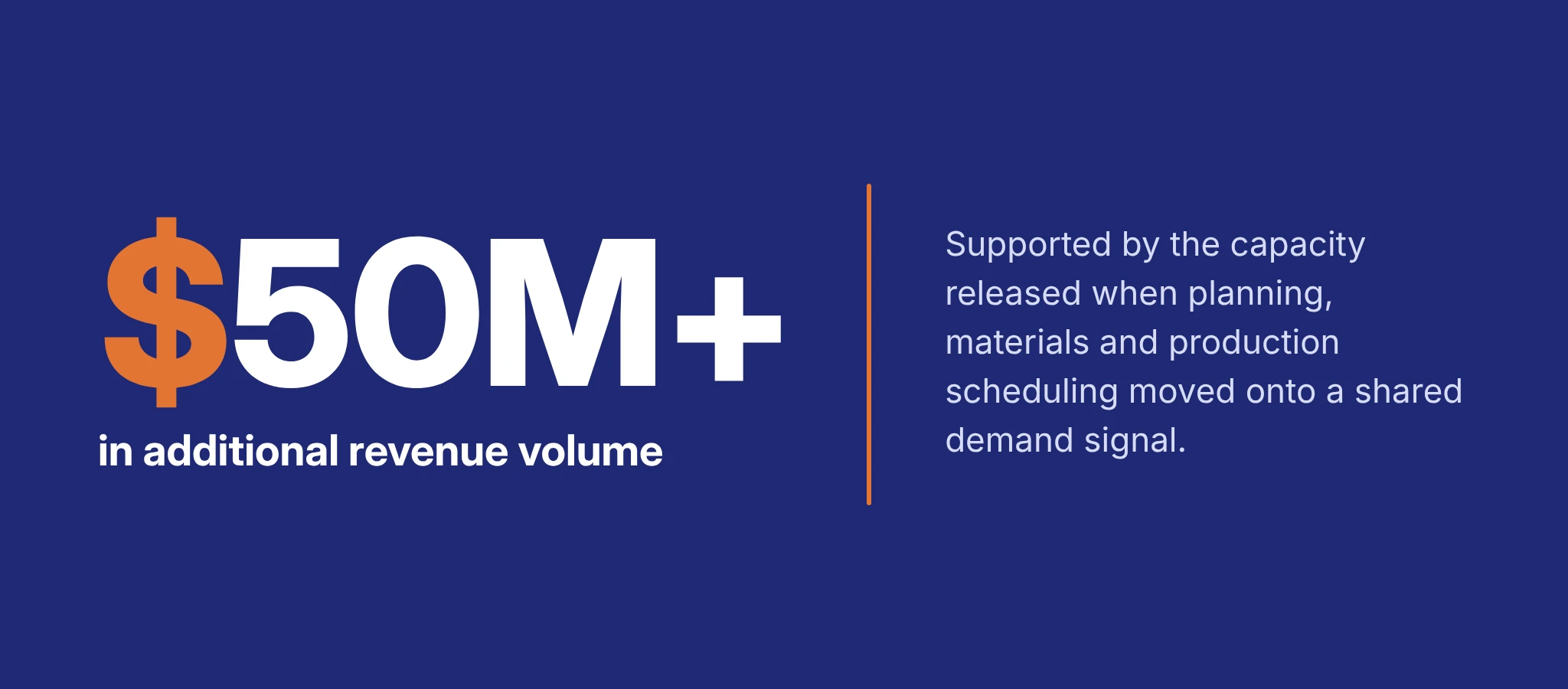
The implemented changes increased schedule adherence to above 95 percent, a strong improvement for a process that had held only one week of visibility. Additionally, past-due status of small production orders improved by 40 percent, and supplier delivery performance improved 5 percent year over year. The capacity released supported more than $50 million in additional revenue volume.
As Mayra Marquez, LaSalle Group's COO, put it: “The biggest change did not come from capital investments or technological investments. We sat down with the owners of planning, materials, production scheduling and manufacturing to get alignment and establish an operating and governance system. This was a foundational action that transformed a reactive manufacturing plant into one that could meet its growth objectives.”
Just-in-time vs. just-in-case
Since the pandemic, many companies have questioned Just-in-Time altogether.
Bain & Company wrote in 2025 that the traditional just-in-time model no longer works in an environment of geopolitical tension and frequent disruption, and McKinsey's 2025 supply chain risk survey found that 45 percent of companies were increasing inventory levels in response to new tariffs.
The answer is not to abandon lean. A lean supply chain designed with strategic buffers is not fragile: it holds inventory where the risk is and flows everywhere else.
5 Questions to Ask Before Implementing a Lean Supply Chain
Efficiency alone decays. In “The Triple-A Supply Chain” (Harvard Business Review, 2004), Hau Lee drew on 15 years of study across more than 60 companies and concluded that chains focused only on speed and cost tend to deteriorate over time, while agile, adaptable and aligned chains pull ahead. In his framing, supply chain efficiency is necessary but not sufficient to outperform rivals.
Use these questions to assess your readiness before removing inventory from the system:
- How accurate is your mid/long term forecast? Measure forecast accuracy at the level you plan, not only in aggregate. Pull systems amplify the cost of a forecast you cannot trust.
- How mature is your supplier performance program? Check whether your key suppliers can deliver smaller, more frequent orders and share capacity and inventory data.
- Is your ERP System fully utilized? If materials planning lives in spreadsheets, fix visibility and master data first.
- Do you know where your critical risks are? Have a strong Sales & Operating Planning process, identify single-source materials and products where a stockout would stop production or affect patients. Those need buffers.
- Which supply chain measures do you have in place, and how do you manage recurring issues to turn them into sustained improvements? The foundation of Supply Chain Excellence resides with a strong operating system, effective measures, and governance.
Frequently Asked Questions
What is a lean supply chain?
A lean supply chain delivers what customers need, when they need it, with the least possible waste of inventory, time and effort across all tiers, from suppliers to distribution.
What are the 5 principles of a lean supply chain?
Value, value stream, flow, pull and perfection, as defined by Womack and Jones in Lean Thinking (1996).
What is the difference between lean manufacturing and a lean supply chain?
Lean manufacturing improves flow inside the plant. A lean supply chain extends that flow to suppliers, inventory policies and replenishment across companies.
Does a lean supply chain mean zero inventory?
No. A lean supply chain removes waste, not protection. It places inventory deliberately at the points of highest risk, as Toyota did with semiconductors after the 2011 earthquake and tsunami hit Japan.
Conclusion
Lean supply chain management remains one of the most effective ways to free capacity, reduce working capital and improve delivery. But it only works when planning, materials and production are integrated. Companies that build that foundation first, and place buffers where the risk is, get the benefits of lean without its fragility.
At LaSalle Group, we help manufacturing sites regulated by the FDA, EMA and other global regulatory agencies to build the foundation and discipline for a lean supply chain. Learn more about our operations consulting services.
Sources
- Bain & Company (2025). Saenz, H., Borchert, A. and Parker, T. Beyond Tariffs: The Supply Chain Reinvention Imperative.
- Christopher, M. and Towill, D. (2001). An integrated model for the design of agile supply chains. International Journal of Physical Distribution & Logistics Management, 31(4), 235–246.
- CSCMP (2025). State of Logistics Report, prepared by Kearney. Figures as reported by Supply Chain Digest, June 13, 2025.
- Demand Driven Institute. Demand Driven Material Requirements Planning (DDMRP).
- Fisher, M. L. (1997). What Is the Right Supply Chain for Your Product? Harvard Business Review, March–April 1997.
- Lean Enterprise Institute. Pull Production (lexicon).
- Lee, H. L. (2004). The Triple-A Supply Chain. Harvard Business Review, October 2004.
- Lee, H. L., Padmanabhan, V. and Whang, S. (1997). The Bullwhip Effect in Supply Chains. Sloan Management Review, 38(3), 93–102.
- McKinsey & Company (2025). Supply chain risk pulse 2025: Tariffs reshuffle global trade priorities.
- McKinsey Global Institute (2020). Risk, resilience, and rebalancing in global value chains.
- Shirouzu, N. (2021, March 9). How Toyota thrives when the chips are down. Reuters.
- Womack, J. P. and Jones, D. T. (1996). Lean Thinking. Simon & Schuster.